




Please Leave Us A Message
Privacy statement: Your privacy is very important to Us. Our company promises not to disclose your personal information to any external company with out your explicit permission.
In the field of PCB manufacturing, copper foil is one of the most fundamental materials, serving key functions such as conducting electricity, dissipating heat, transmitting signals, acting as a seed layer for copper plating, and providing mechanical support. Common types include HTE copper foil, RTF copper foil, VLP copper foil, and HVLP copper foil. What are the differences between them? In which fields are they applied? And how should they be selected?
Both HTE and RTF are electrodeposited copper foils. The core differences lie in their surface morphology and process design, which determine the trade-offs between adhesion, high-frequency loss, and cost. PCB selection is determined by the application scenario.
I. Core Definitions and Process Differences
HTE (High-Temperature Elongation) Electrodeposited Copper Foil
A traditional electrodeposited copper foil. The roughened side faces up and bonds with the resin to achieve high peel strength. It offers good elongation under high-temperature lamination, providing strong resistance to copper cracking and thermal cycling.
RTF (Reverse Treated Foil)
The process is reversed: the smooth side faces down and bonds with the substrate, followed by fine micro-roughening. The two sides are treated differently to balance adhesion and signal loss.
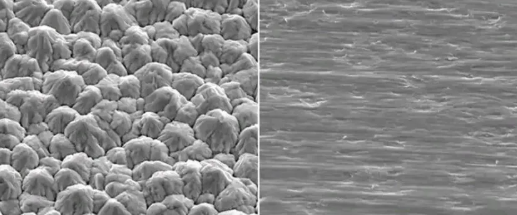
VLP Copper Foil
Full Name: Very Low Profile
Key Features and Positioning: It has relatively low surface roughness and serves as a foundational low-profile copper foil, primarily used in applications requiring high signal integrity. It is widely used in substrates for packaging boards and similar applications.
HVLP Copper Foil
Full Name: Hyper Very Low Profile
Key Features and Positioning: It features extremely low surface roughness (typically Rz ≤ 2.0 μm). As an advanced version of VLP, it is specifically designed for high-frequency, high-speed circuits requiring very low or ultra-low loss, offering the highest performance and cost.
Note: There can be slight variations in industry terminology. The full name "Hyper Very Low Profile" is clearly defined for HVLP, distinguishing it from "high voltage." Additionally, in terms of Chinese naming, manufacturers in the Taiwan region sometimes refer to VLP as "ultra-low profile" copper foil.
III. Application Field Differences
Technical Core: Compared to traditional HTE copper foil and improved RTF copper foil, the core pursuit of VLP/HVLP is to minimize the surface roughness at the interface between the copper foil and resin. This minimizes the "skin effect" loss during high-frequency signal transmission.
Performance Gradient: In terms of signal transmission performance (specifically low loss) and cost, these copper foil types generally follow this progression:
HTE Copper Foil: Standard performance, economical and general-purpose.
RTF Copper Foil: Improved performance with good cost-effectiveness, widely used in mid-loss and low-loss circuits.
VLP Copper Foil: Higher performance for high-frequency, high-speed circuits.
HVLP Copper Foil: Top-tier performance, specifically designed for very low-loss and ultra-low-loss circuits.
Application Selection: The choice of copper foil directly depends on the signal frequency and loss requirements of the circuit board:
Mainstream Communications & High-Speed Computing: Applications like 5G base stations, high-end routers, data center servers (using PCIe 5.0, 800G networks, etc.) typically use HVLP copper foil.
High-End Consumer Electronics & Automotive Networking: Applications like high-end smartphone mainboards, autonomous driving radars, and automotive high-speed gateways may use advanced RTF or VLP/HVLP copper foils depending on specific loss requirements.
General Consumer Electronics & Automotive Control: Applications like home appliances and body control modules can be satisfied with standard HTE copper foil or standard RTF copper foil.
You can consider VLP as the standard answer for low-profile copper foil, while HVLP represents the optimal answer for pursuing ultra-low frequency loss. Currently, driven by the development of 5G, AI data centers, and autonomous driving, the market demand for ultra-low profile copper foils like HVLP is growing rapidly.

September 24, 2026

September 19, 2026
Email to this supplier
September 24, 2026
September 19, 2026
Privacy statement: Your privacy is very important to Us. Our company promises not to disclose your personal information to any external company with out your explicit permission.
Fill in more information so that we can get in touch with you faster
Privacy statement: Your privacy is very important to Us. Our company promises not to disclose your personal information to any external company with out your explicit permission.